Scotch broom absolute (CAS 8023-80-1) — Sweet Heart to base Note Fragrance Ingredient
Scotch broom absolute
CAS 8023-80-1
What Is Scotch broom absolute?
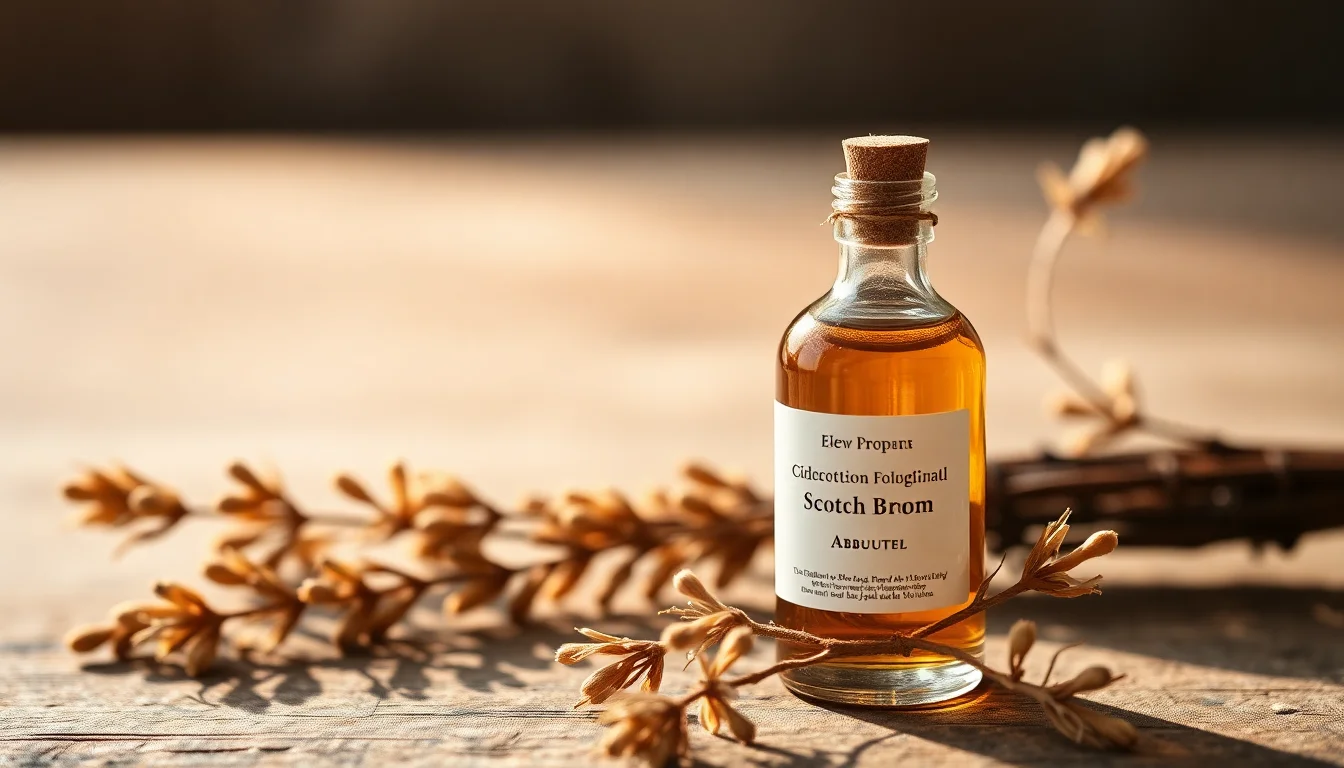
Scotch broom absolute is a rare botanical extract from the yellow-flowered Scotch broom plant (Cytisus scoparius). It’s found in niche perfumery where its honeyed, hay-like aroma adds rustic warmth. This material matters because it captures the essence of sun-drenched countryside meadows, offering perfumers a natural alternative to synthetic hay accords.
Safety Profile
USE WITH AWARENESSWhat Does Scotch broom absolute Smell Like?
Scotch broom absolute unfolds like a summer day compressed into scent – initial bursts of sun-warmed hay and pollen give way to a heart of honeyed florals with a waxy, almost beeswax-like texture. The dry-down reveals subtle phenolic nuances reminiscent of pipe tobacco, lingering as a soft skin scent. Unlike most floral absolutes, it carries a distinctive animalic undertone that recalls the warmth of fur or leather.
In Famous Fragrances
Fragrance associations may not reflect actual formulations.
Used minimally here to add a sun-baked hay nuance that complements the cardamom-cumin spice, creating the illusion of heat rising from dry earth.
The broom absolute’s honeyed animalic facets reinforce the civet in this classic, adding rustic warmth to the lavender-citrus opening.
Chemistry, Properties & Perfumer Guide
The Chemistry
Scotch broom absolute is a complex natural mixture containing methyl anthranilate, coumarin derivatives, and various terpenoids. The characteristic hay-like scent comes from phenylacetaldehyde and related aromatic compounds. Extraction typically involves petroleum ether or hexane to yield a waxy concrete, followed by alcohol washing to produce the absolute. The composition varies significantly based on geographic origin and harvest time.
Physical & Chemical Properties
| Appearance | Dark orange to brown viscous liquid |
|---|---|
| Solubility | Soluble in alcohol, insoluble in water |
Perfumer Guide
| Application | Typical % | Range | Notes |
|---|---|---|---|
| Fine Fragrance | 0.5-2% | Up to 5% | Used as supporting note in chypres and fougères |
| Home Fragrance | 0.1-1% | Up to 3% | Adds natural warmth to candles and diffusers |
Classic Accords
Tip: Use with citrus top notes to brighten the hay-like facets and prevent excessive heaviness.
Alternatives & Comparisons
More intensely hay-like but lacks the honeyed floral character of broom. Use when a sharper dried grass note is needed.
Synthetic alternative that captures the orange blossom-honey aspect but misses the phenolic complexity.
Safety, Regulatory & Sustainability
⚠ Regulatory Disclaimer
General reference only. Consult current IFRA Standards Library before formulating.
IFRA Status
No specific IFRA restrictions, but general guidelines for botanical absolutes apply (max 0.5% in leave-on products).
EU Allergen Declaration
Contains naturally occurring coumarin derivatives which may require declaration above 0.01% in leave-on products.
GHS Classification
RIFM Assessment
RIFM assessment pending – currently classified as ‘Data Gap’ pending further studies on sensitization potential.
Sustainability
Scotch broom is considered invasive in some regions, making sustainable harvesting challenging. Some producers cultivate broom specifically for perfumery to prevent ecological damage. The extraction process is solvent-intensive, though some producers now use supercritical CO2 methods. Synthetic reconstructions are being developed but currently lack the full complexity of the natural absolute.
Explore Scotch broom absolute
Browse essential oils and aroma compounds.
Browse on iHerb →Affiliate disclosure: we may earn a small commission at no extra cost to you.
References
- Arctander, S. (1960). Perfume and Flavor Materials of Natural Origin.
Data: PubChem (NIH), PubMed, RIFM, IFRA. Last reviewed: Apr 2026.
Report a data errorIngredient Data Sheet
CAS 8023-80-1Odor & Flavor
| The concrete is obtained by extracting the dried flowers in approximately 0.1% yields with petroleum ether; the absolute is prepared by alcoholic extraction of the concrete. A tincture is also prepared from the absolute. It has a sweet, honey-like, intense odor that characterizes all other derivatives. The deep herbaceous coumarinic background has great tenacity.📖 Fenaroli |
Regulatory Status
| IOFI Classification | Natural📖 Fenaroli |
Physical data: PubChem (NIH/NLM), U.S. EPA CompTox Dashboard, EPA OPERA models, RDKit. Odor & flavor: Arctander (Perfume & Flavor Chemicals), Fenaroli's Handbook of Flavor Ingredients, Leffingwell. Thresholds: van Gemert (Compilations of Odour Threshold Values). Regulatory: IFRA Standards 51st, FEMA GRAS. Trade names: Surburg (Common Fragrance & Flavor Materials). All data compiled and cross-referenced for perfumertools.com.
Related Research
- 2-Furanmethanethiol formate (CAS 59020-90-5) — Sweet Top to middle Note Fragrance Ingredient
- Ethoxylated castor oil (CAS 61791-12-6) — Citrus None Note Fragrance Ingredient
- 5,9-Dimethyl-4,8-decadienal (CAS 762-26-5) — Citrus Top Note Fragrance Ingredient
- Tricyclo[3.3.1.1.(3.7)]decan-2-ol, 4-methyl-8-methylene- (CAS 122760-84-3) — Woody Base Note Fragrance Ingredient
![Benzoic acid, 2-[(1-hydroxy-3-phenylbutyl)amino], methyl ester (CAS 144761-91-1) — Balsamic Middle to base Note Fragrance Ingredient](https://thegoodscents.company/wp-content/uploads/2026/04/benzoic-acid-2-1-9-768x439.webp)
![5H-Cyclopenta[h]quinazoline, 6,6a,7,8,9,9a-hexahydro-7,7,8,9,9-pentamethyl- (CAS 1392325-86-8) — Woody Base Note Fragrance Ingredient](https://thegoodscents.company/wp-content/uploads/2026/04/5h-cyclopenta-h-quinazoline-6-6a-7-8-9-9a-hexahydro-7-7-8-9-1-1-768x439.webp)